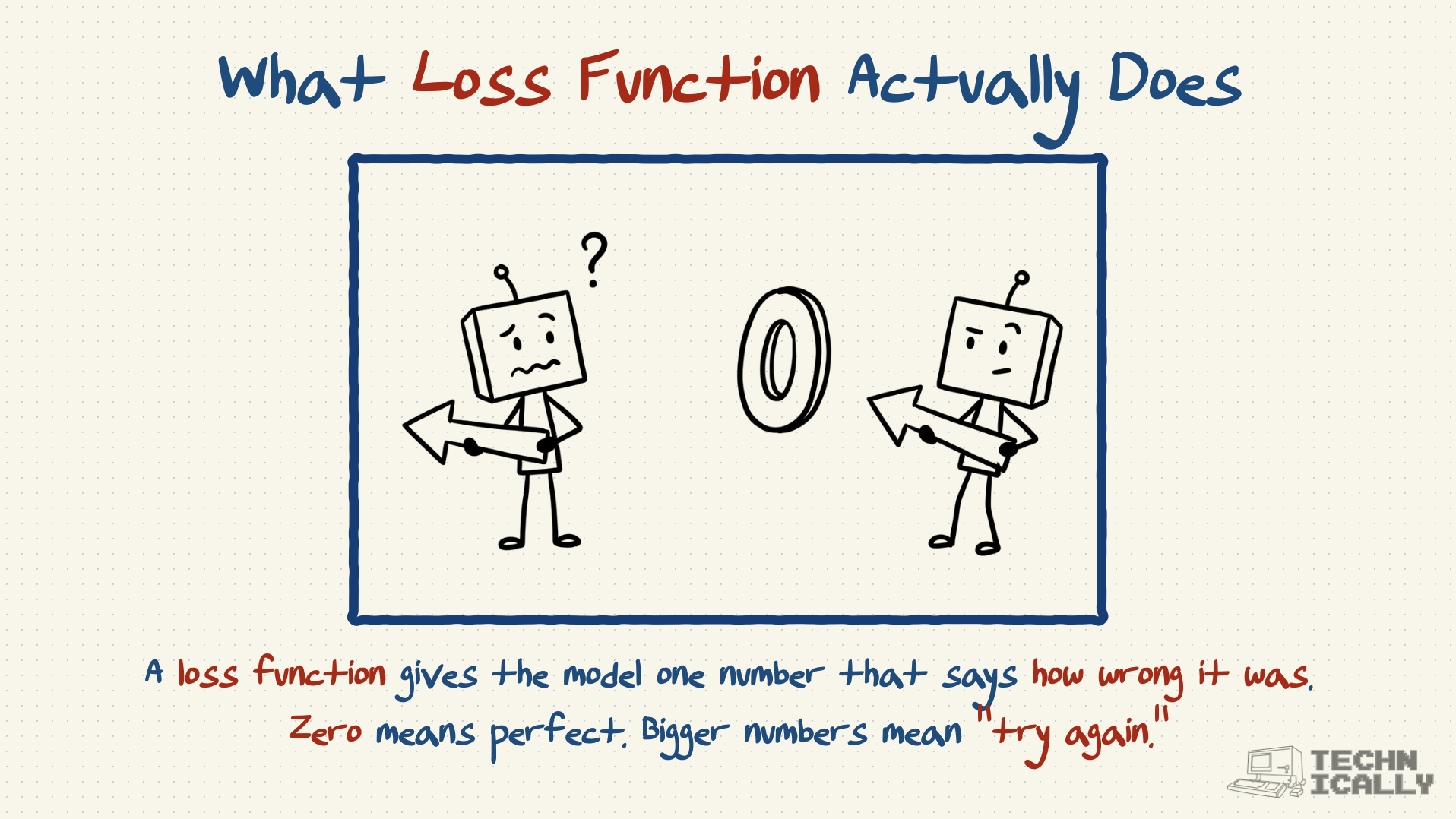
When training a machine learning model, a loss function is something you design that tells the model when its answers are right and when they're wrong.
- It's like a scoring system that gives the model feedback on how well it's doing
- Different types of tasks need different loss functions (classification vs. prediction)
- The model uses this feedback to gradually improve its performance
- Think of it as the "teacher" that grades the AI's homework and helps it learn
Loss functions are where the actual learning happens - they turn the vague goal of "get better" into specific mathematical feedback.
What is a loss function?#
I keep mentioning these 'fancy algorithms' and it's now time to discuss those. The magic that happens when a model digests your data and learns a pattern is actually not magic it all; it's math. Specifically, models use something called a loss function to figure out if they're doing well or not.
A loss function is something you design that tells the model when its answers are right and when they're wrong. There are a bunch of different types, some catered to specific ML tasks like image classification (bugs) or regression (stock prices).
Here's the problem a loss function solves: imagine you're teaching someone to shoot free throws, but you can only communicate through a single number. If they make the shot, you say "0" (no error). If they miss, you say how far off they were. Over time, they learn to adjust their technique to minimize that number. That's essentially what a loss function does for AI models.
How do loss functions work in practice?#
In Iowa, one way this can go down is that your model will start by guessing at random whether an image has a bug in it. If it's right, it gets a point. If it's wrong, it loses a point. After enough of these iterations, it starts to learn what means bug and what doesn't.
On Wall Street, your model is trained slightly differently. It plots all of the stock price fluctuations on a graph and uses a loss function to find the most likely relationship between time and price. If the line is good, it gets a few points. If it's bad, it loses a few points.
The Iowa example uses what's called a classification loss function - the model is trying to put things into categories (bug vs. no bug). The Wall Street example uses a regression loss function - the model is trying to predict a continuous number (stock price).
What are different types of loss functions?#
Different tasks need different types of feedback, so there are several flavors of loss functions:
Classification Loss Functions #
For tasks where you're sorting things into categories (spam vs. not spam, cat vs. dog):
- Cross-entropy loss: Penalizes confident wrong answers more than uncertain wrong answers
- Hinge loss: The classic "support vector machine" approach - focuses on getting the decision boundary right
Regression Loss Functions #
For tasks where you're predicting numbers (stock prices, temperature, sales):
- Mean squared error: Penalizes big mistakes way more than small ones
- Mean absolute error: Treats all mistakes more equally
Advanced Loss Functions #
For complex tasks like generating images or text:
- Adversarial loss: Two models compete against each other to improve
- Contrastive loss: Teaches the model to distinguish similar from different examples
How do loss functions "tell" models if they're right or wrong?#
This is where the math gets interesting, but the concept is straightforward. During training, here's what happens:
Step 1: Make a Prediction #
The model looks at an example (like a photo) and makes its best guess ("I think this is a cat").
Step 2: Calculate the Loss #
The loss function compares the prediction to the correct answer and outputs a number representing how wrong the model was.
Step 3: Adjust the Model #
Using calculus (specifically, gradients), the model figures out which of its internal settings to tweak to reduce the loss next time.
Step 4: Repeat #
This happens millions of times until the model gets good at minimizing the loss function.
The beautiful thing is that models learn to minimize whatever you measure. Design your loss function well, and the model learns exactly what you want. Design it poorly, and the model optimizes for the wrong thing entirely.
Why do different tasks need different loss functions?#
Because different tasks have different definitions of "getting it right." Consider these examples:
- Medical Diagnosis: Missing a cancer case (false negative) might be way worse than a false alarm (false positive). Your loss function should penalize missed cases more heavily.
- Spam Detection: False positives (good emails marked as spam) might be more annoying to users than false negatives (spam getting through). Adjust accordingly.
- Stock Prediction: Being off by $1 when the stock is at $100 is different from being off by $1 when it's at $10. Percentage-based loss functions handle this better.
- Content Generation: There's no single "right" way to complete a sentence, so you need loss functions that can handle multiple valid outputs.
What happens when you choose the wrong loss function?#
Your model optimizes for the wrong thing, often in spectacular fashion. Some famous examples:
- The Paperclip Maximizer: A thought experiment where an AI told to maximize paperclip production eventually converts everything on Earth into paperclips because that's what it was optimized for.
- Gaming the Metric: Real systems that were optimized for "time spent on platform" started showing users increasingly extreme content because outrage keeps people engaged longer.
- Medical AI Bias: Models trained on loss functions that only cared about overall accuracy learned to ignore rare diseases that mostly affect minority populations.
The lesson? Your loss function is your model's definition of success, so choose carefully.
How do you know if your loss function is working?#
You watch what the model actually learns to do, not just whether the loss number goes down. Here are some warning signs:
- The model is "gaming" the system: Loss goes down but real-world performance doesn't improve
- Weird edge case behavior: The model does bizarre things in situations you didn't think to test
- Overconfidence: The model is very sure about predictions that are obviously wrong
- Underconfidence: The model is uncertain about things it should know
Good loss function design is part science, part art, and part careful observation of unintended consequences.
Frequently Asked Questions About Loss Function#
Can you change the loss function during training?#
You can, but it's usually not a great idea. Changing the loss function mid-training is like changing the rules of the game while someone's learning to play - it tends to confuse the model rather than help. Most people stick with one loss function for the entire training process.
Do modern AI systems use just one loss function?#
Nope, often they use combinations of multiple loss functions. ChatGPT, for example, uses different loss functions during pre-training (predict the next word), instruction tuning (be helpful), and RLHF (match human preferences). It's like having multiple teachers giving feedback on different aspects of performance.
How do you design a custom loss function?#
Very carefully, and usually by starting with existing loss functions and modifying them. You need to think about what you actually want the model to do, what failure modes you want to avoid, and how to balance different objectives. It often takes several iterations to get right.
Can loss functions be biased?#
Absolutely, and this is a huge concern in AI ethics. If your loss function doesn't account for fairness across different groups, your model will learn to be unfair. For example, a hiring algorithm might optimize for "historical hiring patterns" and perpetuate existing biases.
What's the most common mistake with loss functions?#
Optimizing for the wrong thing because it's easier to measure. For example, optimizing a recommendation system for "clicks" instead of "user satisfaction" often leads to clickbait. The metrics you choose to optimize become your reality, so choose wisely.